The Fall Between Rooms
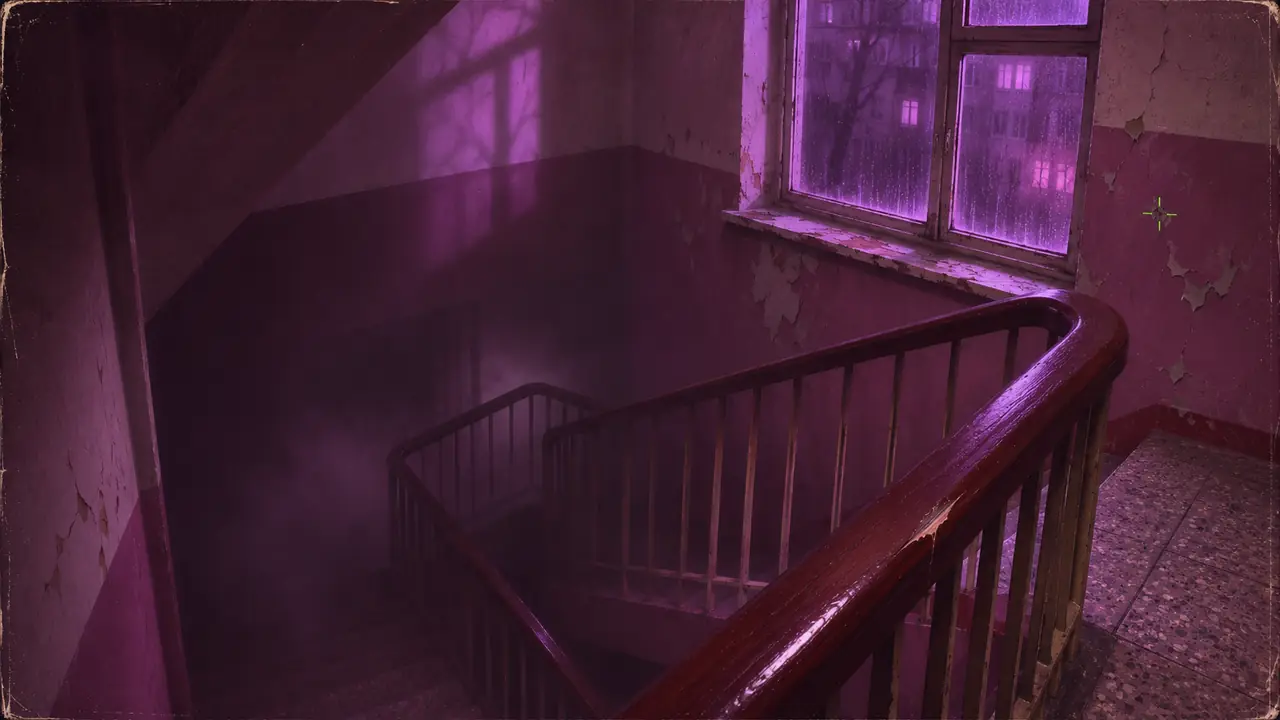
The witness in this concept remembers an open hand above a stair rail and a strike somewhere below it. The two moments are adjacent in the account. Nobody can see the lower landing from the place where the witness recalls standing. The first reconstruction therefore has a sound, a visible gesture and an interval whose length is still open.
Build a sequence with a place left empty
You can stop on the rail and rotate within the limits of the remembered view. Its top edge contains a nick that stays visible as the hand passes. Below it, a wall hides most of the lower flight. An initial examination creates a trace for the opening hand and another for the sound. Move either trace on the reconstruction strip and the interface shows which other events have to move if you insist on keeping them together.
The basic loop is to review the fragment, place a trace, walk the visible part of the stair and then check the placement. A trip back to the upper landing can recover where a hand was, but it does not fill in the part that was out of sight. You can then leave the destination unresolved and try a hypothesis that involves a separate object behind the dividing wall.
Listen from the remembered position
The sound changes according to where the scene is heard. At the top of the stair there is a short strike with a softer return. On the lower run, the return arrives differently because the wall no longer separates it from the listener. These differences can help compare two interpretations, but the recorded trace holds only what the witness claims to have heard. You can replay the comparison without updating the original automatically.
The art uses worn varnish to show when the rail bends away. A reflected purple strip on a polished edge supplies depth even when the landing is dim. The green marker appears only on a feature the investigator has deliberately selected. It remains readable at a distance without turning the corridor into a trail of prompts.
Decide what the placement is for
A sequence can direct a later visit even while it contains a contradiction. If you mark the sound after the gesture, the next review starts at the interval between them. If you place it before the gesture, the corridor before the opening hand becomes the lead. Both choices keep the uncertainty attached to that one relationship. A readout explains which observation would help you choose a firmer order.
The concept is in prototype development. Our present exercise checks whether a player can stop at the wall and explain why the strike alone does not locate the object. The opening scene and the sound review are the pieces we are using to test that point. The sound design note explains how the two traces first became separate controls. The clock note follows the same distinction as it applies to a remembered time.
Return to Memory Traces to keep the frame with the rail beside the separate corridor case. The comparison shows the type of uncertainty in each project before you attempt to connect any of the details.